
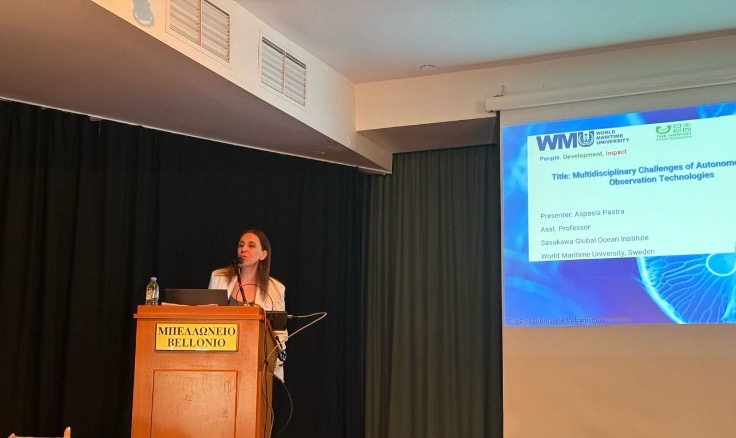
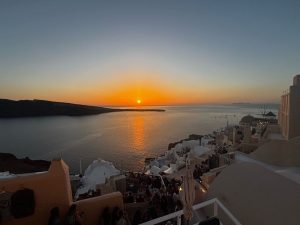
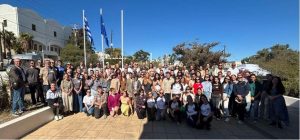
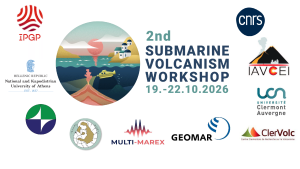
From October 19–22, 2026, Santorini served as an international hub for marine geosciences, hosting the 2nd Submarine Volcanism Workshop at the Bellonio Cultural Center in Fira. Santorini is one of the five volcanic centers that make up the southern Aegean volcanic arc. The workshop connected scientists from volcanology, seismology, geodesy, and hazard studies, fostering international collaboration. It convened over 100 researchers from 66 institutions across 21 countries to address long-standing challenges in sub-seafloor processes and marine geohazards.
2nd Submarine Workshop
integrating geophysics, sampling and ocean floor imaging for a better understanding of submarine volcanoes
Key Scientific Takeaways & Future Directions
The Future Ocean Program, Pillar 3 on autonomous underwater technologies, underlined that unmanned technologies already serve various fields: biodiversity, MGR, ocean mapping, and geohazards. The challenges are multidisciplinary: legal regimes within and beyond the EEZ, data, technology, and people. No single discipline can solve them; science and law must work side by side. We need to build the human capacity to make ocean data FAIR: Findable, Accessible, Interoperable, and Reusable.
For more information, please contact the WMU-Sasakawa Global Ocean Institute at goisecretariat@wmu.se.
About the World Maritime University
The World Maritime University (WMU) in Malmö, Sweden is established within the framework of the International Maritime Organization, a specialized agency of the United Nations. The mission of WMU is to be the world centre of excellence in postgraduate maritime and oceans education, professional training and research, while building global capacity and promoting sustainable development. WMU is an organization by and for the international maritime community and is committed to the United Nations 2030 Agenda for Sustainable Development.
About wmu-goi
The World Maritime University (WMU)-Sasakawa Global Ocean Institute (GOI) is an independent focal point for the ocean science-policy-law-industry-society interface where policymakers, the scientific community, regulators, industry actors, academics, and representatives of civil society meet to discuss how best to manage and use ocean spaces and their resources in accordance with the United Nations 2030 Agenda for Sustainable Development. The Institute was inaugurated in May 2018 and made possible through generous support from The Nippon Foundation of Japan, the Governments of Sweden, Canada, and Germany, as well as the City of Malmö.