
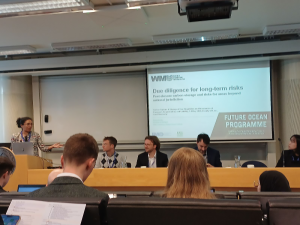
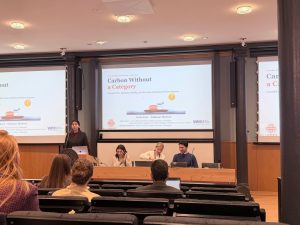
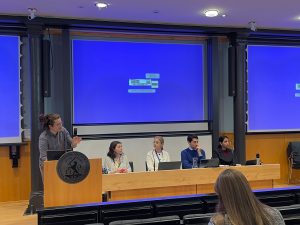
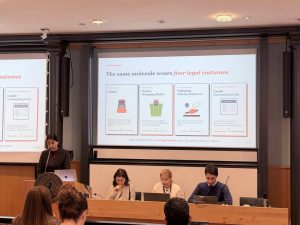
Dr. Vonintsoa Rafaly, Postdoctoral Fellow and Akrita Kaur, Project and Research Support Intern at the World Maritime University (WMU)-Sasakawa Global Ocean Institute (GOI) delivered presentations at the CCS at Sea 2026 Conference themed “Carbon Capture & Storage (CCS) at Sea: Regulation and Governance of Transport, Sequestration, and Liability” held on 7-8 May 2026 at Faculty of Law, Lund University, in collaboration with the Department of Law at the School of Business, Economics and Law University of Gothenburg.
ccs at sea 2026 conference
regulation and governance of transport, sequestration, and liability
about the conference
The conference explored the growing role of Carbon Capture and Storage (CCS) in international climate strategies, with a particular focus on the legal, governance, and liability challenges surrounding the maritime transport and sub-seabed storage of captured CO₂. Discussions addressed issues including cross-border regulation, environmental risk, liability frameworks, and the governance of offshore carbon storage.
about wmu-goi presentations
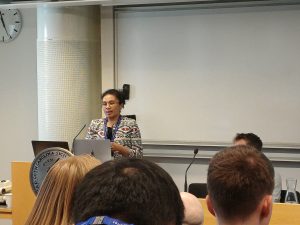
Her presentation, titled “Due Diligence in Carbon Storage: An Appraisal of Time in the Law of the Sea”, examined the temporal dimensions of due diligence, to address risk management and states liability arising from long-term carbon storage at sea. The paper builds on recent developments — the Advisory Opinions of ITLOS (2024) and the ICJ (2025), and the entry into force of the BBNJ Agreement in January 2026 — that together are reshaping the ocean governance landscape. It questioned the timescales within which due diligence obligation can effectively operate in relation to carbon storage activities. Moreover, the paper explores how liability and risk management frameworks may apply to century-scale risks, particularly when carbon storage poses risks to areas beyond national jurisdiction. Ultimately, the paper sheds light on the relevance and scope of due diligence in the law of the sea in addressing long-term risks to the marine environment arising from legitimate ocean activities and the trade-offs they entail
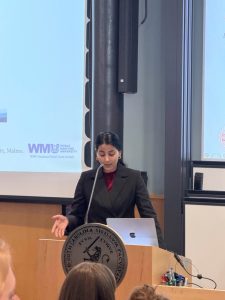
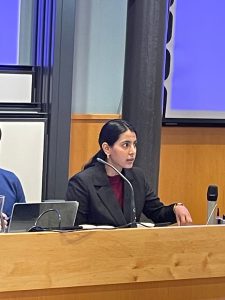
Her presentation, based on a paper co-authored with Rukhsaar Dhaliwal of Panjab University, India, was titled “Carbon Without a Category: Liquefied CO₂, Maritime Liability, and the Limits of Existing Pollution Regimes.” The paper examined how the rapid operationalisation of CCS at sea has outpaced the development of coherent international liability frameworks governing the maritime transport and sub-seabed sequestration of captured CO₂. It argued that existing international maritime liability conventions, originally designed to address oil pollution and hazardous substances, do not squarely apply to CCS activities due to the ambiguous legal classification of liquefied CO₂ under international maritime law.
For more information please contact the WMU-GOI at goisecretariat@wmu.se
About the World Maritime University
The World Maritime University (WMU) in Malmö, Sweden is established within the framework of the International Maritime Organization, a specialized agency of the United Nations. The mission of WMU is to be the world centre of excellence in postgraduate maritime and oceans education, professional training and research, while building global capacity and promoting sustainable development. WMU is an organization by and for the international maritime community and is committed to the United Nations 2030 Agenda for Sustainable Development.
About wmu-goi
The World Maritime University (WMU)-Sasakawa Global Ocean Institute (GOI) is an independent focal point for the ocean science-policy-law-industry-society interface where policymakers, the scientific community, regulators, industry actors, academics, and representatives of civil society meet to discuss how best to manage and use ocean spaces and their resources in accordance with the United Nations 2030 Agenda for Sustainable Development. The Institute was inaugurated in May 2018 and made possible through generous support from The Nippon Foundation of Japan, the Governments of Sweden, Canada, and Germany, as well as the City of Malmö.